For visitors
- Home
- TELZ YESHIVA
- For visitors
M. K. Valančius’s Silva rerum and Telšiai
By resolution of the Seimas of the Republic of Lithuania, 2026 has been declared the Year of Motiejus Kazimieras Valančius, Bishop of Samogitia. In adopting this decision, the Seimas followed Article 1 of Resolution No. XIII-975 of 21 December 2017 on the procedure for declaring commemorative years, taking into account the importance of preserving Lithuania’s historical, political and socio-cultural memory and of honouring events, personalities and anniversaries of significance to the state.
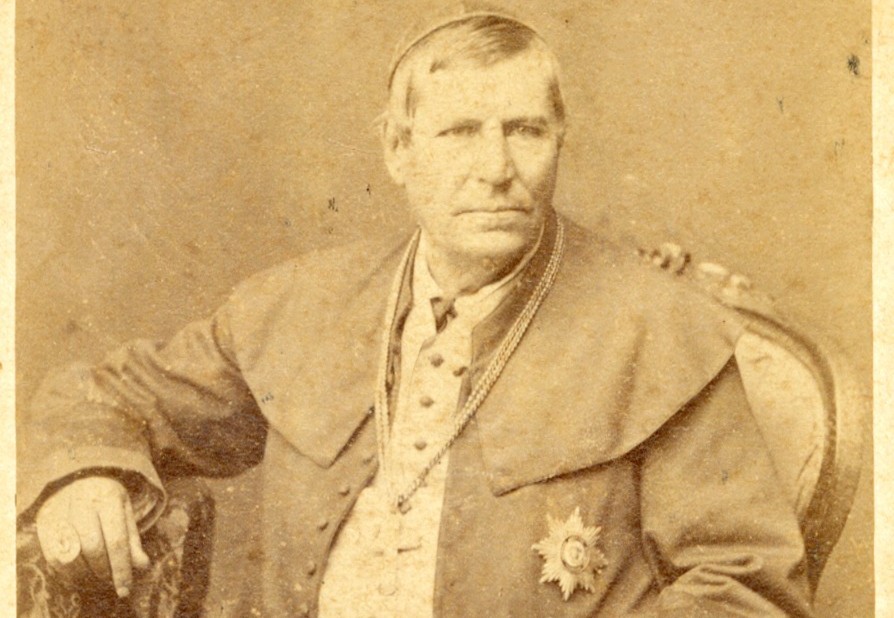
Motiejus Kazimieras Valančius, Bishop of Samogitia, educator, writer and organiser of the temperance movement, was born on 16 February 1801. He was one of the most important figures in the religious, cultural, social and political life of mid-19th-century Lithuania, making a significant contribution to the development of Lithuanian scholarship and to the advancement of education and culture.
As we approach the jubilee year of this distinguished Samogitian, let us turn to Bishop M. K. Valančius’s Home Notes — Silva rerum (a manuscript book in which texts of interest to its owner were copied). These notes allow us to encounter authentic, uncensored material imbued with the spirit of the age and to discover what the eminent bishop wrote about Telšiai. Valančius wrote his Silva rerum — Pamiętnik domowy — in Polish; it was translated into Lithuanian by Dr Aldona Prašmantaitė. The book Namų užrašai (Home Notes) was published in 2003. It contains information about the church in Telšiai, the school (gymnasium), the prison, priests, the cholera epidemic, the insurgents of 1863, the repressions and Russification policies carried out by the Russian authorities, as well as subtle references to the activities of Valančius himself.
Excerpts
On 16 December 1842, by decree of the Russian Tsar, the office of provincial superiors of monasteries was abolished and the post of diocesan visitor was introduced, carrying an annual salary of 400 silver roubles. These officials, chosen from among the most suitable clergy and subordinate to the diocesan authorities, were required to supervise all monasteries in the diocese directly and to sit in the diocesan consistory. In the Diocese of Telšiai [in 1842], the first visitor appointed by Bishop Prince Simonas Giedraitis was Prince Martynas Giedraitis, Prelate of Telšiai (p. 191).
A decree of 20 October 1843 from the Tsar to the Governing Senate stated: “Having approved the staffing structures of educational institutions in the governorates of Vilnius, Kaunas and Minsk, submitted by the Minister of Education and considered by the State Council, and adapted to the new composition of these governorates, We order: 1) that the time for introducing these staffing structures in the educational institutions already in operation be left to the discretion of the Minister of Education; according to the new staffing structures, We intend to open a department at the gymnasium of Grodno Governorate, and in Telšiai to reorganise the district school attached to the Bernardine monastery into a school for the nobility, once it has been established that this can be done from the funds allocated to the Ministry of Education” (p. 209).
In 1843, Liudvikas Jucevičius, a Catholic priest and curate of Svėdasai in Ukmergė district of the Diocese of Vilnius, fell in love with Miss Žurauskaitė, the daughter of a local landowner. When his feelings were returned, he decided to marry her. To that end, the two travelled to Telšiai and informed the local Orthodox priest that they wished to convert to the Orthodox faith. Finally, despite the objections of the young woman’s parents and with the permission of Archbishop Semaško, they renounced the Catholic faith and were married. Thereafter they wandered about under universal contempt (p. 217).
Yesterday [14 September 1844], a sad funeral ceremony took place in the local cathedral for the late Bishop of Adramyttium, Simonas Mykolas Giedraitis, who had governed the Diocese of Telšiai. His remains were brought here on 12 September from his residence in Alsėdžiai, where on 7 August he had surrendered his soul to God, mourned with deep sorrow by his relatives and by the diocese he had led. After the body had been embalmed and the customary rites performed, and with large crowds gathered in heartfelt grief at the painful loss of their shepherd, these mortal remains were escorted by the assembled clergy and by relatives both near and distant [...]. As the cortege passed through the district town of Telšiai, it was received with due respect by the local monastic clergy and by the civil and military officials of the town. The procession then turned towards the Bernardine church, where, accompanied by funeral hymns and appropriate music, a requiem Mass was celebrated, after which one of the priests of the Order delivered a funeral sermon. Following the sermon, the procession accompanying the bishop’s body continued. All those who had come to receive the funeral procession, as well as many others weighed down by grief, walked with it as far as the town gate (pp. 346–347).
[In 1845] there was still no Orthodox church in Telšiai, although a priest sent by the authorities lived in the town and held services in a private house. [At the present-day intersection of Kalno and Mažoji Kalno streets] in November 1845, Veščezerov, the Orthodox priest of Telšiai, who was suffering from tuberculosis, fell gravely ill. Seeing death approach, and with no other Orthodox priest available, he urgently begged his household to summon Father Justinas Valavičius, guardian of the Bernardine friars, but the latter, fearing the strict prohibitions imposed by the authorities, did not go. Finally, the priest asked for a candle from the Catholic church to be brought to him; when it was given to him, he kissed it, raised his hands to heaven, and died. The cause of his death was vodka, which he drank excessively every day despite his illness (p. 385).
From 1844 onwards, the district school in Telšiai passed entirely into secular hands, whereas until then several Bernardine friars had served there as teachers. At that time the head of the school was Bazaninas, while the first chaplain was Juozapas Beržanskis, Candidate of Theology and a diocesan priest (p. 387).
[In 1848] cholera nevertheless continued to rage. [...] During the following [November] month, in Telšiai it claimed the lives of 127 Jews and 15 Christians. Among the dead was the clerk Jonas Lileika, a guberniya secretary, who imprudently ate a small quantity of mushrooms. A student named Balabanas also died after eating sour milk (p. 465).
In Varniai, an obvious informer was the parish schoolteacher Beinaravičius, and when cholera carried him off, the post was taken over by Mr Klevenskis, professor of Russian at the seminary. When he was somehow forced out of Varniai, [in 1854] another man was sent, even worse than the first, also as a seminary teacher: Teoftistov. Teoftistov, the son of an Orthodox priest from Vladimir Governorate, had studied at the pedagogical school in St Petersburg. When the institute sent him out into the world, it gave him the highest recommendation; but once he had to teach others, it became clear that he knew nothing. He had a particular fondness for writing denunciations, especially against Bishop Valančius and the seminary rector, the Reverend Aleksandras Beresnevičius, his superiors. Yet because he was barely literate, every time he wished to submit a complaint he had to travel to Telšiai and look for helpers who knew Russian, so that he could denounce the innocent. Because of these complaints, the bishop had to travel to Vilnius several times to explain himself to Governor-General Ilja Bibikov and to the secret police (p. 503).
In addition, the Minister of the Interior ordered that the prefect of the Telšiai school, Lukaševičius, should visit the seminary every month. His visits were especially unpleasant for the seminary, since even the money that had to be paid on each occasion did not always secure a favourable assessment (p. 505).
[In 1851] “On 22 April I visited the monastery and church of the Bernardine fathers in Telšiai and administered Confirmation to 3,410 persons of various estates” (p. 715).
[In 1855] On 23 September, 165 persons received Confirmation in the former Bernardine church in Telšiai (p. 737).
[In 1855] Jonas Krizostomas Gintilovskis, otherwise known as Gintila, was born in 1788 in Telšiai district, in the village of Gelindėnai. He first attended school in [Samogitian] Kalvarija and later in Telšiai. After completing several classes, he abandoned his studies and entered service in the so-called Telšiai palestra [court], but, having no hope of advancement because of his origins, he left for Vilnius. After living there for some time and seeing how difficult it was to find any position, he entered the clerical estate at the Main Seminary at the expense of the Diocese of Mogilev, since that diocese had sent no one. This took place in 1807 (p. 515).
At the end of July 1858, invited by the Reverend Stanislovas Gruzdys, parish priest of Plateliai, I travelled to Telšiai on 1 August for the indulgence feast known as the Portiuncula. There, on 2 August, I celebrated Mass solemnly and administered Confirmation to 342 persons.
On the third day, which was Sunday, in the company of the Reverend Fathers Dovydaitis, my secretary, Laurynas Barkauskas, parish priest of Seda and dean of Alsėdžiai, Moncevičius, parish priest of Telšiai, and others, I solemnly consecrated the high altar of Plateliai church in honour of the Holy Apostles Peter and Paul (p. 759).
[In May 1858] on the 29th, I returned home through Telšiai. In Telšiai I visited the prison, that is, the public jail, where there were 200 inmates (p. 763).
The parish priest of Telšiai, the Reverend Joakimas Moncevičius, having dismantled the former high altar that had stood in the middle of the church, moved it to the far end of the building. That church had once been consecrated by Suffragan Bukata; naturally, the high altar could not remain unconsecrated. Therefore, invited by the said Reverend Moncevičius, [in 1859] I set out on 29 August. At the boundary of Telšiai parish I was met by 200 horsemen. As I approached the town, I was surrounded by a great crowd of people. At the church I found about 40 priests waiting. According to the customary rites, I placed the relics of the Holy Martyrs Constantine, Clement and Aurelia in the cemetery chapel, beside which people sang throughout the whole night. The following day, on 30 August, I consecrated the high altar under the title of Our Lady of Loreto. On the same day, Father Moncevičius was installed as parish priest. On the 31st, I administered Confirmation to 947 persons and returned home (pp. 768–769).
[In 1860] On 13 June, in Telšiai, I administered Confirmation to 25 persons (p. 771).
In 1861, the nobility, inspired by patriotic feeling, sang patriotic hymns in churches. The supporters of such singing were so numerous that the clergy could not resist them. Those who objected were subjected to ridicule of various kinds. Some priests, moved by the same spirit, joined in the singing, among them Petras Chadaravičius, filial priest of Girdžiai; Antanas Stankevičius, curate in Skirsnemunė; Alfonsas Kareiva, chaplain of Panevėžys Gymnasium; three Augustinians from the Kaunas convent; Liudvikas Montvidas, parish priest of Panevėžys; Joakimas Moncevičius, parish priest of Telšiai; Andrius Gabševičius, chaplain of Kaunas Gymnasium; and Mackevičius, curate in Panevėžys. Such behaviour, hostile to Russia, displeased the government. Father Gabševičius was exiled to Petrozavodsk; Fathers Chadaravičius and Stankevičius were detained in Vilnius for a couple of months and then released. Fathers Montvidas and Moncevičius were deprived of their parishes. The fate of the others is unclear. Since my subordinates were deemed guilty, the government counted me among the guilty as well. For that reason, at the summons of the illustrious Count Pyotr Valuyev, Minister of the Interior, I travelled to St Petersburg. I left Varniai on 8 November. On the way, in Joniškis, I administered Confirmation to 18 persons. I remained in the capital until 29 December. I returned home before Epiphany, in frost reaching 26 degrees (p. 783).
[In 1862] On 14 May, in Telšiai, I administered Confirmation to 236 persons, prayed with those gathered, and then continued on my way [to Samogitian Kalvarija] (p. 785).
[In 1862] On 1 November, during the Feast of All Saints, I celebrated High Mass in the cathedral with the papal blessing. There was a great multitude of people. The Reverend Father Gabaliauskas, specially invited from Telšiai, delivered a sermon in Lithuanian. He urged the people to renew their temperance pledges. They renewed them. We sang Veni Creator, and I bestowed the blessing. This measure proved quite successful, for Father Gabaliauskas, a well-known preacher, addressed the people with great persuasiveness (p. 793).
At the beginning of May 1863, insurgents came to the town of [Samogitian] Kalvarija and forced the Reverend Father Pilypas Mokšeckis to proclaim the Polish manifesto. For this, the Russian authorities immediately arrested him and took him to Telšiai prison. On 8 June I was informed that Father Mokšeckis was to be shot the following day. I set out at once for Telšiai to save him and, through a messenger, wrote to General Maydel in Šiauliai that I was taking Father Mokšeckis under my responsibility. I visited the persons involved in the matter. In the church at Telšiai, on 9 June, I administered Confirmation to 62 persons (p. 795).
A total of 105 priests of the Diocese of Samogitia were accused of participating in the uprising of 1863–1864; they were repressed, exiled to Siberia, or even shot. Joakimas Moncevičius, parish priest of Telšiai, did not take part in the uprising, but was later exiled to Hrodna following police intervention. In 1870 he returned to the Dominican monastery in Raseiniai (p. 587).
The following priests were imprisoned in Telšiai prison: Antanas Gargasas, an inmate of the correctional house [in Varniai], a drunkard, was among the insurgents; having been brought by them to the correctional house, he was shot in Telšiai in 1863. Izidorius Noreika, curate of Gargždai, an unruly man, gathered a group, was captured by Cossacks near Samogitian Šatės, and in 1863 was shot in Telšiai on the same day as Father Gargasas (p. 587).
Pilypas Mokšeckas, of the Order of Preachers at the convent of [Samogitian] Kalvarija, an outstanding preacher, was held in Telšiai prison and then exiled as far away as Tunka (p. 593).
Stanislovas Gruzdys, parish priest of Plateliai, because Mr Grosas came to him together with the insurgents, spent almost a year in Telšiai prison, was tried, paid 300 roubles to the military governor Muravyov, and returned to Plateliai to resume his former duties. His troubles cost him dearly in other ways as well (p. 697).
Laurynas Barkauskas, parish priest of Seda, as soon as he heard the disturbance in the town, hurried out into his parish and returned only after the insurgents had left. However, denounced by Kryzicki, the district police chief of Telšiai, he lost his parish. I granted him an altar benefice in Palanga. The Russians came from Telšiai to Seda, seized the insurgents’ banner, and restored the old order (p. 697).
Bishop M. K. Valančius himself was forced by the Russian authorities, on 3 December 1864, to move to Kaunas. He was fined 6,200 roubles, threatened with deportation deep into Russia, and forbidden to leave Kaunas (p. 595).
Janina Bucevičė
Historian at the Samogitian Museum “Alka”
Update: 2026-04-09