
The Samogitian Museum “Alka” was officially established on 16 February 1932. However, the origins of the museum date back to 1922, when museum collections began to be assembled at the Telšiai Teachers’ Seminary on the initiative of its director, Juozas Gedminas. Although the seminary was relocated to Plungė in 1930, this did not prevent museum enthusiasts from founding the “Alka” Museum, dedicated to preserving the heritage of Samogitia and active to this day.
On 14 August 1931, a group of patriots from the Samogitian region formed the Society of Antiquity Enthusiasts “Alka”, with the aim of fostering Samogitian culture, language, and history, and establishing a museum.
The first exhibition was opened on 16 February 1932 in a three-room apartment at 31 Birutė Street. At that time, the museum held around 400 exhibits. Pranas Genys, a native of Telšiai and chairman of the Society, was appointed as the museum’s first director. The foundation of the museum was formed by the collections gathered by J. Gedminas and members of the “Alka” Society.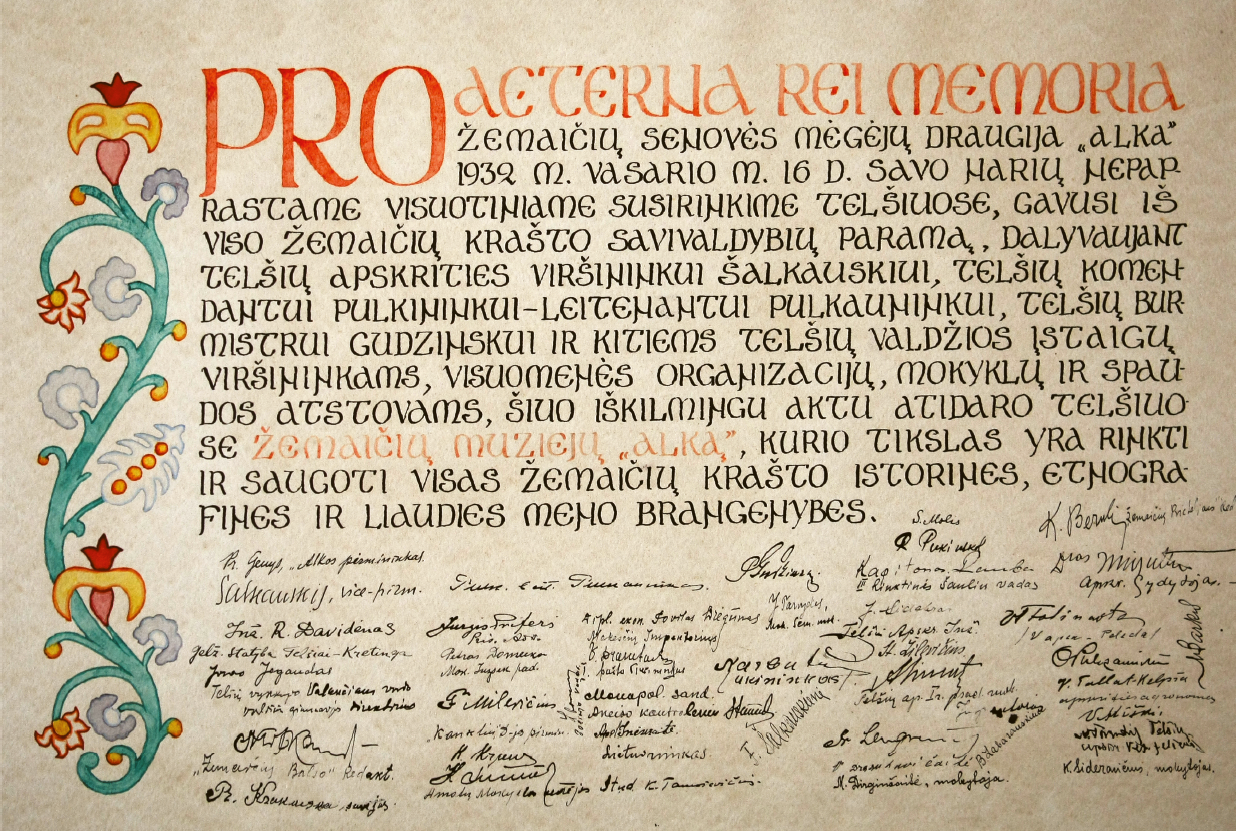
Official opening act of the Samogitian Museum “Alka”, 16 February 1932
As the rented wooden apartment on Birutė Street posed a fire risk and was unsuitable for museum purposes, the museum was relocated on 1 October 1932. It moved to new premises on what was then President Antanas Smetona Street (now Respublika Street), into a brick house owned by Pranas Girdvainis, where four rooms were rented.
By 1933, as the growing collection outgrew the available space, the Society decided to raise funds for a purpose-built museum on Žaliasis Hill near Lake Mastis. A modern building design was prepared by architect Steponas Stulginskis. Financial support and construction materials were donated not only by local municipalities, but also by individuals, organisations, businesses, the Government, and the Ministry of Education.
In 1936, the cornerstone of the new museum building was consecrated on Žaliasis Hill, and just two years later the museum opened its doors to visitors. The Samogitian Museum “Alka” quickly became a cultural centre: it organised exhibitions, collected artefacts, carried out expeditions, and hosted various gatherings and meetings.
Although the museum’s development was affected by the Second World War and the prolonged Soviet reoccupation, it remained an important cultural institution, continuing to expand its collections and establishing itself as the leading museum in Samogitia, covering fields from archaeology to contemporary art.
The museum’s collections expanded most significantly in the summer of 1940, following the adoption of the Law on the Protection of Cultural Heritage by the new Lithuanian government. A large number of valuable items—documents, paintings, sculptures, furniture, and books—were transferred to the museum from nationalised estates of noble families in Samogitia, including the Tiškevičius, Oginskis, Pliateris, Choiseul, and Gorskis families. These items now form the museum’s core collection.
Thanks to the efforts of Pranas Genys, the most valuable artefacts were hidden during the war in safe locations with trusted individuals in rural areas, as well as in a specially constructed hiding place within the museum itself. After the war, nearly all items were returned, although a small number were damaged or lost due to inadequate storage conditions.
In recent decades, the museum has significantly expanded its services, built a collection of nearly 160,000 items, and increased visitor numbers. It has also incorporated three branches: the Samogitian Village Museum, the Museum of the Diocese of Samogitia in Varniai, and the Telz Yeshiva.
Historical video story about the construction of the modernist-style Samogitian Museum “Alka”.
To enable English subtitles, click “LT” in the top right corner of the video player and select English.
Last updated: 2026-04-01
