For visitors
- Home
- TELZ YESHIVA
- For visitors
The Paragaudis Band: Between Birth and Death
One of the oldest and best-preserved woven woollen bands in Lithuania was discovered during excavations at the Paragaudis cemetery in Šilalė District. In 1973, a team from the Telšiai Museum of Local History, led by Vitas Valatka, the first archaeologist in Telšiai, uncovered 71 graves and traces of a further 91 disturbed graves on a low hill. At this Late Iron Age cemetery, the dead were generally buried uncremated, lying on their backs with their legs extended and their arms arranged in various positions. Traces of coffins hollowed out of oak logs were also found.
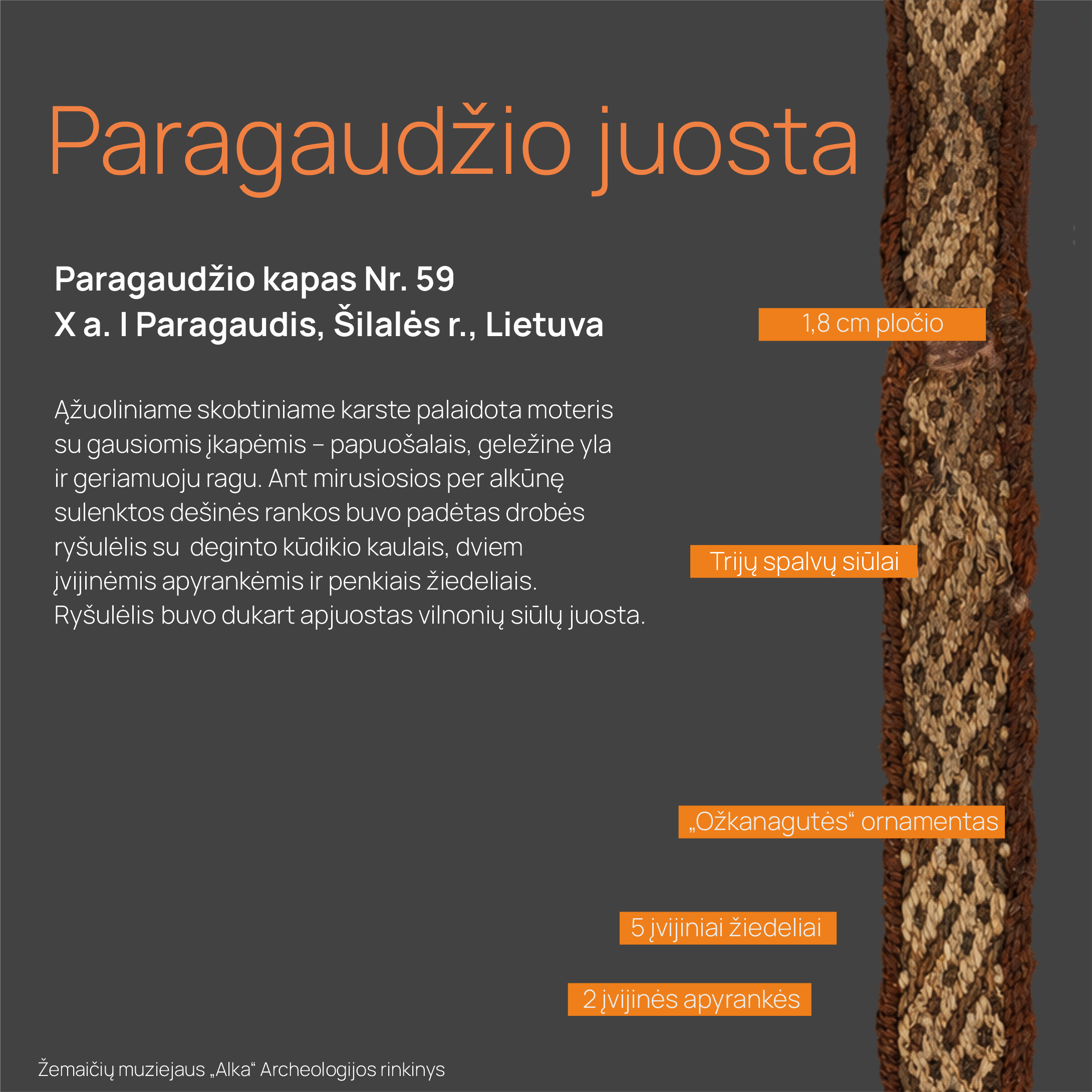
One grave pit, 2 metres long, 0.5 metres wide and 0.7 metres deep, contained the remains of a coffin and the skeleton of a woman. A brass chain encircled her skull, and a twisted brass neck ring and a necklace made of chain links were found around her neck. Two brass spiral rings were found on the fingers of her left hand and two brass cross-shaped pins lay at her chest. A drinking horn with a silver-plated fitting had been placed beside her right thighbone. Her right arm was bent sharply at the elbow. Resting on it was a linen bundle containing the cremated bones of an infant and the grave goods placed with them – two spiral bracelets and five small spiral rings. The bones and grave goods had been wrapped in linen, and a woven band, just 1.8 centimetres wide, had been wound twice around the bundle. The band was woven using a pick-up technique with wool yarn in three colours. Its pattern consists of a repeating stylised S-shaped motif known in Lithuanian as ožkanagutė, or ‘little goat’s hoof’. The band documents an unusual infant burial and preserves a motif that can still be found in Lithuanian folk art more than a thousand years later. Only a handful of examples of twined bands are known from the Lithuanian archaeological record.
Pregnancy and childbirth carried considerable risks in the Viking Age, but it is difficult to say what happened to the woman and infant buried at Paragaudis. European burial evidence shows that infants were sometimes buried alongside men, older children or elderly women. Sharing a grave can tell us how two people were laid to rest, while their relationship in life often remains uncertain. Even when infant burials survive only in fragments, they can show how differently people laid infants to rest, from a Stone Age burial in which an infant was placed on a swan’s wing to shared graves of the Viking Age. Sometimes all that remains of a life between birth and death is an amber bead, a few small shells, a pin or a woollen band. Sometimes it is a few small bones, wrapped in a woman’s dress or in a shroud, or buried without any grave goods at all.
The Paragaudis band is on display in the renewed permanent exhibition at the Samogitian Museum ‘Alka’, which opened to visitors in autumn 2024.